Technical Diving Agencies Compared: What the Standards Actually Require

Most divers arrive at technical training with an agency already attached to them. You did your open water with PADI or SSI, and whether one was better than the other was probably settled by whichever shop happened to be nearest the beach.
The same comparison comes back when you start looking at technical courses, and this time it is worth more thought. The courses are longer, cost several times as much, and the limits printed on the card genuinely constrain what you are allowed to go and do afterwards.
The framing I find most useful is this: the agency sets a floor, and the instructor largely decides how far above it you end up. Plenty of experienced divers would put it differently, and some would argue the agency's culture matters more than I allow here.
What follows compares the floors — the minimums each agency publishes for the same rung — because those are the part that can be checked against a source. It is a narrower comparison than the question deserves, but it is the part where evidence is available.
What the agency fixes, and what it does not
| The agency decides | The instructor decides |
|---|---|
| Prerequisite certifications and logged dives | How far past the minimum you actually go |
| Minimum training dives and days | Whether you are failed, or sent away to dive more |
| Depth and gas limits on the card | What you can really do when the course ends |
| Maximum students per instructor | Whether that maximum is ever used |
| Whether courses may be combined | Whether combining them suits you |
| Whether a rating carries across rebreather units |
A good deal of what determines whether you finish a course competent sits in that right-hand column.
So this article does not try to say which agency produces better divers. I have not seen evidence that would support such a claim either way, and what we do hold — reviews naming individual instructors — tends to describe the person rather than the badge. That is suggestive rather than conclusive: our reviews are drawn from public sources and skew towards instructors people felt moved to write about.
Why this comparison is hard, and how we did it
Three problems make most agency comparisons shakier than they look.
The courses have different names. TDI's Decompression Procedures, PADI's Tec 45 and IANTD's Advanced EANx are the same rung with three different signs over the door. You cannot compare them until something establishes that they are the same rung.
The standards are hard to find. Some agencies publish them openly; others keep them behind a members' login, which makes some claims harder to verify than others.
They change. A table typed out by hand tends to drift from the source within a year or two, usually without anyone noticing.
What we have done about it: every tier below comes from our own cross-agency mapping, every row links to the agency's own published standard so you can check it, and the tables are generated from the course data rather than typed out. That reduces drift rather than eliminating it, and the mapping itself involves judgement calls — reasonable people could place a few of these courses differently.
Where an agency words its entry requirement without a dive count, the table says so with a dash rather than inventing a number.
The same rung, different front doors
Start with the first real decompression course — the rung TDI calls Decompression Procedures.
| Agency | Their course | Logged dives | Source |
|---|---|---|---|
| PADI TecRec | Tec 45 | 50 | standard |
| IANTD | Advanced EANx Nitrox Diver | 30 | standard |
| TDI | Decompression Procedures | 25 | standard |
Broadly the same depth and gas, and in practice a comparable certification — with twice the logged dives asked at one agency as at another.
It would be easy to read that as one agency being lax and another rigorous, and I do not think that holds up. A minimum is a judgement about who should be allowed to start, and an instructor at the lower-minimum agency is free to ask for more before accepting a student. Many do. Equally, a higher minimum is a real filter, and some would argue it changes who ends up in the water.
What the number reliably tells you is where you would currently be turned away. With 30 logged dives, the agency you pick may be the difference between starting this season and waiting.
The gap widens with depth
At the deep end the spread stops being a technicality.
| Agency | Their course | Logged dives | Source |
|---|---|---|---|
| IANTD | Trimix Diver | 200 | standard |
| PADI TecRec | Tec Trimix Diver | 150 | standard |
| SSI XR | Hypoxic Trimix | 100 | standard |
| TDI | Advanced Trimix | 100 | standard |
| RAID | Hypoxic Trimix | — | standard |
One hundred logged dives at one agency, two hundred at another, for a certification to broadly the same depth on the same gas.
One way to read that is as each agency expressing a view about how much diving ought to sit behind a given card. The agencies have differed on this for decades, and the disagreement looks genuine rather than careless on either side.
Cave, where the specialists live
| Agency | Their course | Logged dives | Source |
|---|---|---|---|
| SSI XR | Full Cave Diving | 75 | standard |
| IANTD | Cave Diver | 50 | standard |
| NSS-CDS | Cave Diver | 50 | standard |
| NSS-CDS | Advanced Cave Diver | — | standard |
| RAID | Cave 2 | — | standard |
| TDI | Full Cave | — | standard |
Cave is worth looking at separately because the agency list changes. NSS-CDS is a cave-only organisation, the oldest in the discipline, and it appears here alongside the generalists.
Specialist agencies tend to publish tighter, more specific standards, because they are writing for one environment rather than all of them.

The rebreather rule nobody mentions until it costs them
This is one of the sharper divergences between agencies, and it stays invisible until you want to teach.
For divers, crossing to a different rebreather works much the same way everywhere: a short crossover re-qualifies you at the level you already hold.
For instructors, the agencies split:
- IANTD — your teaching level carries across units. A MOD 3 instructor can teach MOD 3 on a different machine, subject to loop hours on it.
- TDI, SSI XR, PADI TecRec, RAID and GUE — you teach from MOD 1 again on the new unit, issuing certifications to climb back up the levels you already held.
If you intend to teach rebreathers on more than one machine, that difference is likely to cost you more time and money than most of the other factors in this article. How much depends on how many units you end up teaching.
It is also why our unit pages group each instructor's ratings by which rule they fall under, rather than listing them flat.
GUE is a different question entirely
Everything above compares agencies that are, structurally, doing the same thing in slightly different orders. GUE is not in those tables, and that is deliberate.
GUE does not map onto the ladder. Its courses are not alternative front doors to the same rungs; they are a different programme with its own sequence, and pooling them into a cross-agency range would misrepresent both sides.
The numbers show why. GUE's published prerequisites, from their own standards:
| Course | Requires |
|---|---|
| Technical Fundamentals | 75 non-training dives, 25 of them past 21 m, plus 25 dives in doubles |
| Technical Diver 1 | Technical Fundamentals, plus 100 logged dives beyond entry level |
| Cave Diver 1 | Technical Fundamentals, plus 100 logged dives |
| CCR Fundamentals | Technical Fundamentals, plus 150 non-training dives |
GUE also asks that divers be non-smokers and physically fit — conditions I have not found stated by the other agencies here, though absence from a published standard is not quite the same as absence of any expectation.
Set against a first decompression course you can start with 25 logged dives elsewhere, that is a substantial difference in what is being asked before you begin.
The part that actually costs money
The standards are only half of it. GUE standardises equipment configuration, and that has a price attached.
If you have already bought kit for a TDI or IANTD path, moving to GUE may mean changing parts of it. If you start with GUE and later want to train elsewhere, you will find your configuration is fine but your habits are built around a system other instructors may not teach.
Going down both paths is entirely possible. It is simply more expensive than either alone, and worth knowing before you buy a wing.
An honest opinion, labelled as one
GUE is more conservative than the mainstream agencies, and the reasoning behind it is coherent: the standardisation means any two GUE divers can dive together without negotiating configuration first, which has obvious value on a demanding dive. Divers who have come up through it tend to speak well of what it did for their precision and teamwork, and that is worth weighing.
The counter-argument, which I find persuasive but others do not, is that it can become restrictive if treated as the only legitimate way to dive. There are excellent divers who came up elsewhere, and there are dives where adapting your configuration is the sensible answer. Where exactly that line sits is genuinely contested.
My own view, offered as a view rather than a finding: there are skills worth taking from both sides. The precision and team discipline are real and transferable, and so is the flexibility of agencies that let you configure for the dive in front of you. I do not think you have to pick a tribe, though plenty of people I respect disagree.
That is as far into the DIR question as this article goes. It is a long-running argument with sincere people on both sides, and it has less bearing than you might expect on where to train next month.
A way to approach the decision
This is how I would go about it. It is not the only sensible order.
1. Check which floors you clear. With 30 logged dives, the tables above show which doors are open to you now. This is the part the agency genuinely decides.
2. Weigh the agency less heavily once two or three will take you. At that point the choice of person tends to matter more, at least in my experience. Many instructors in Thailand, Mexico and Florida teach several agencies' syllabi and will happily advise which card suits your plans.
3. Spend your effort on the instructor. This is where I would put most of the research time, and there is more on how at the end of this article.
The clearest case for letting the agency drive the decision is the rebreather instructor rule above. If teaching on several units is part of your plan, that one is worth deciding first and working backwards from.
Frequently Asked Questions
Which technical diving agency is best?
There is no good evidence that one agency produces better divers as a rule. Agencies set minimum prerequisites, depth limits and student ratios; how far beyond those minimums a course goes is largely down to the instructor, and many divers find that is what shapes the outcome. A reasonable approach is to check which agencies' prerequisites you currently meet, then choose on the instructor.
How many logged dives do you need for a decompression course?
It varies by agency for the same certification. At the Advanced Nitrox / Decompression Procedures rung, published minimums range from 25 logged dives at TDI to 30 at IANTD and 50 at PADI TecRec. For hypoxic trimix the spread is wider still: 100 at TDI and SSI XR, 150 at PADI TecRec, 200 at IANTD.
Is TDI or PADI better for technical diving?
They teach broadly the same rungs under different names and with different entry requirements — PADI TecRec generally asks for more logged dives to start, TDI fewer. Neither card appears to carry more weight than the other in practice, though opinions differ. Availability is often the deciding factor: TDI is more widely taught outside Europe and North America, while PADI TecRec is easier to find at recreational centres adding technical training.
Does an IANTD rebreather instructor rating carry across units?
Yes. IANTD teaching levels carry across rebreather units, subject to loop hours on the new machine. TDI, SSI XR, PADI TecRec, RAID and GUE require an instructor crossing to a new unit to teach from MOD 1 again and build back up. For divers rather than instructors, a crossover re-qualifies you at your existing level at all of them.
How is GUE different from TDI and IANTD?
GUE runs its own sequence rather than alternative versions of the same rungs, with substantially higher entry requirements — Technical Fundamentals alone asks for 75 non-training dives and 25 in doubles, and divers must be non-smokers and physically fit. It also standardises equipment configuration, which carries a real cost if you have already equipped for another path. It is more conservative by design; whether that suits you depends on the diving you want to do.
Start with the instructor, not the agency
If there is one thing to take from all of the above, it is this: the agency decides whether you may begin, and the instructor shapes what you can actually do at the end of it. Once two or three agencies will accept you, the person teaching matters more than which logo goes on the card.
So the useful next step is not to pick an agency. It is to find instructors you would want to learn from, and see which agencies they teach.
Browse technical diving instructors — filter by location, agency, course and rebreather, and read what their students actually wrote.
Each listing carries a synthesis of the reviews that name them and aspect tags drawn from those reviews, so you can look directly for the qualities you care about: instructors described as not waving students through, as patient and willing to add time, or as a go-to for cave. Shortlist a few and put them side by side in compare.
Then ask the ones you like which agency they would certify you under, and why. In my experience most will have a reasoned answer, and several teach more than one syllabus anyway.
If you would rather read round the subject first: the agency pages list who teaches each one — TDI, IANTD, PADI TecRec, SSI XR, RAID, GUE, NSS-CDS — and how much it costs to start technical diving and how much it costs to start cave diving cover the money.
Prerequisites are as each agency publishes them, linked from every row. Standards change; if you find a row that no longer matches the source, tell us and we will correct it.
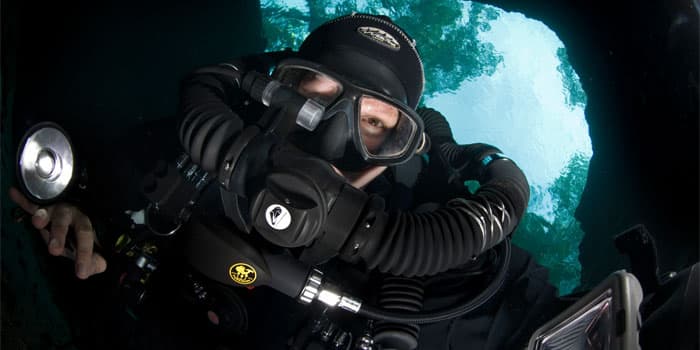
Cover photograph: a technical diver at Challenger seamount, by Jill Heinerth for NOAA Ocean Exploration, Bermuda Deep Water Caves 2011 (public domain).

Nick is a cave and technical diver — he built to help fellow tec divers find the right instructors, centres, and tools.