Which Rebreather Should You Pick? Here Are a Few Ways to Decide
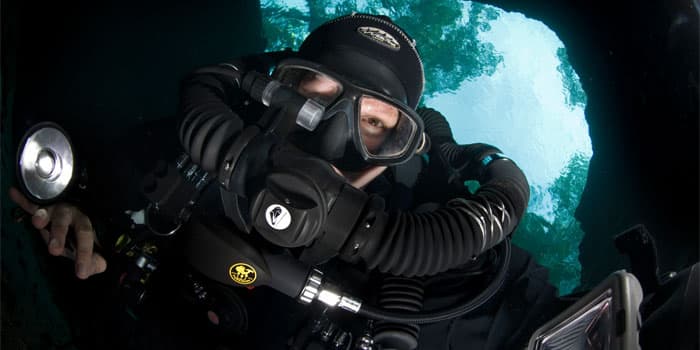
There is no best rebreather. There is a best rebreather for the diving you intend to do, and four questions get you to it — in this order:
- What kind of diving is this for? This decides whether you want a backmount, a sidemount or a chest-mount unit — and that is the decision everything else follows from.
- How does it fit the kit you already own? A chest-mount clips onto the doubles or sidemount rig you dive now. A backmount replaces it.
- How do you want the oxygen controlled? Electronics holding your setpoint, or your own thumb.
- Can you get taught, serviced and filled for it where you live? This one is a veto, not a preference.
Here is the short answer, before any of the reasoning:
| If your diving is | You want | Units to look at |
|---|---|---|
| Cave, with restrictions | Sidemount for the lowest profile; chest-mount if you want to stage it | Sidewinder, Gemini, Liberty SM, SF2 SM, S7, Choptima |
| Cave, big passage | Either; backmount buys scrubber and gas | JJ-CCR, Fathom, rEvo, Megalodon, Liberty |
| Deep boat dives, wrecks, trimix | Backmount, usually eCCR | JJ-CCR, SF2, Inspiration Vision, PRISM 2, Liberty |
| You dive doubles and want to keep them | Chest-mount | Choptima, Symbios, Triton, Flex 2 |
| You already dive sidemount | Sidemount — but the two kinds are not the same machine | Sidewinder, Gemini, Liberty SM, SF2 SM |
| Flights every trip | Compact backmount or chest-mount | Evolution, Choptima, S7, rEvo Micro |
Then check that list against who can teach you, which is the last section of this article and the one most likely to overrule everything above.
Start with the diving, not the machine
Rebreather arguments online are almost always about the wrong variable. Work of breathing, scrubber geometry and electronics architecture are real engineering differences, and they are downstream of a much blunter question: where does the unit have to sit on your body for the diving you want to do?
Restrictions decide vertical profile
In a cave, the limiting dimension is usually your height in the water, not your width. A backmounted unit puts a rigid canister and counterlungs behind your spine, which adds to exactly the dimension a restriction measures.
Sidemount units are the answer to that. The canisters sit down your sides, level with cylinders you were carrying anyway, and your back stays flat.
This is not a preference, it is a gate. If your ambition includes passage you have to turn sideways for or take a unit off for, the backmounted units come off the list and stay off.
Open water rewards the opposite
On a deep boat dive nothing is squeezing you, and the priorities invert.
You want scrubber duration, gas volume, somewhere to hang bailout, and a unit that sits still while you descend a shot line with your hands busy. Backmount does all of that better: bigger canisters, onboard cylinders, and a clean front for stage and deco bottles.
Bailout is the underrated half of this. On open circuit at 70 m you plan bailout as cylinders you carry or stage; a backmounted CCR leaves your chest and hips free for them. A chest-mount with two sidemount cylinders is a beautiful cave rig and a more awkward place to hang three deco bottles.
Depth and duration are unit-specific, and published limits are not the whole story
Most units have a CE depth rating, and most manufacturers will tell you the unit goes deeper with trimix diluent and a modified bailout plan. AP Diving says its Inspirations have been dived past 110 m many times.
But the practical ceiling can be lower than the paper one.
One cave diver with roughly 350 hours on a KISS Sidewinder wrote for InDEPTH that he treats it as a 70 m unit, and "not a great trimix unit", because of how its valves behave at extreme depth.
That is one experienced opinion, not a specification. But it is the kind of thing to ask an instructor who has taken your candidate unit deep, rather than reading the brochure.
Backmount, sidemount or chest-mount
Three places a rebreather can live. They dive differently, fail differently and suit different divers, and this is the decision every other one follows from.
| Position | What it is good at | What it costs you |
|---|---|---|
| Backmount | Scrubber duration, onboard gas, and a clean front for stage and deco bottles | Adds to your height in the water — the dimension a restriction measures |
| Sidemount | The lowest profile available, with weight down your sides rather than on your back | Less scrubber, and on most units your cylinders feed the loop as well as your bailout |
| Chest-mount | Work of breathing and access. The loop sits at chest height and everything is in front of you. Goes on the rig you already dive, and unclips to be staged | Puts volume on your front — you are thicker through the chest, not thinner |
Chest-mount: breathing and reach
The case for a front-worn unit is not that it makes you smaller. It does the opposite — the unit sits on your chest, so you are thicker through the front than you were on open circuit. Nobody should buy one expecting to fit through more.
The case is work of breathing and access.
A loop worn on your chest sits close to your lung centroid, which is the position hydrostatic balance likes best in horizontal trim. That is the design argument for front-worn counterlungs generally, and it is why chest-mount divers tend to describe the breathe as easy.
Access is the other half, and it is underrated until you need it. The DSV, the add valves, the cells and the scrubber are all in front of your face where you can see them and reach them with either hand. On a backmounted unit, a lot of that is behind you and known by feel.
It also unclips and stages like a cylinder — pushed ahead, pulled through, or left at a known point. That is genuinely useful in an overhead, though doffing and re-donning a rebreather at every restriction is far more annoying in practice than it sounds in a shop.
And it goes on whatever you already dive. Dive Rite says the O2ptima CM is compatible with "sidemount, back mounted doubles, or even a single", which means your existing cylinders become bailout rather than becoming redundant.
Sidemount, which is two different machines
This is where shortlists go wrong. "Sidemount rebreather" covers two arrangements that have little in common beyond where they hang.
Split-scrubber: the Sidewinder and Gemini type
The scrubber is split into two canisters, one worn on each side, with the counterlungs on your back. Experienced divers only half-jokingly describe these as "split-backmount, not really sidemount" units, because that is what the loop actually is.
What you get is the lowest vertical profile available, with weight that is symmetrical left to right.
That combination is why the Sidewinder has been responsible for an enormous amount of the cave line laid in the last decade.
The Sidewinder 2 keeps the arrangement and enlarges it: square moulded canisters that clip into the backplate, carrying 3.5 kg of sorb against the original's 2.2 kg.
What you also get is a unit that does not carry its own gas. Your sidemount cylinders are the diluent supply as well as the bailout, so cylinder handling and loop supply become the same problem.
You also need a sidemount harness that suits it. The unit is designed to be worn onto a rig you already own and dive well.
A unit in a cylinder position: the Liberty Sidemount type
Here the rebreather is a single object about the size of a bailout cylinder, clipped where a tank would sit. That sounds like a smaller difference than it is.
The Divesoft Liberty Sidemount carries all of its gas on board — two 2-litre cylinders, no off-board supply required. Divesoft claims it as the only sidemount rebreather that does this.
The consequences are real:
- Your sidemount cylinders become pure bailout, rather than doing double duty
- The unit is neutrally buoyant by design
- It is usable as a second, redundant rebreather on a big dive
It is also 19 kg dry, all of it on one side, with 5.5 litres of counterlung and a water trap in the exhale side.
The SF2 Sidemount is the same rigid SF2 housing worn at the side, with manual control and external gas supply. It attaches to your harness on a stainless rail and two boltsnaps.
Its party trick is the conversion kit: the same unit converts between sidemount and backmount, which no other manufacturer offers.
One thing to check before you order. Scubaforce states that the CE update for the SF2 Sidemount is still pending, and that it is sold exclusively outside Europe.
The KISS Sidekick is the older, smaller idea in this family — a single canister in a hard shell, aimed squarely at cave and sump exploration.
So which one?
- Open water, depth, duration, plenty of bailout — backmount.
- Tightest passage, and you already dive sidemount well — split-scrubber sidemount. Nothing has a lower profile.
- You want the loop self-contained, or a redundant second unit — Liberty Sidemount. Gas on board changes your bailout planning for the better.
- You want the easiest breathe and everything within reach — chest-mount.
- You dive doubles as often as sidemount, or want one unit for both — chest-mount, or the SF2 with its conversion kit.
How it gels with the kit you already dive
This is the question that changes the real cost of the decision, and almost nobody asks it before they have bought.
A chest-mount goes on what you already own, whatever that is — sidemount, doubles or a single. For a diver with a sorted rig and habits they trust, that is the cheapest and least disruptive route onto a loop, and a large part of why these units have spread so fast.
A split-scrubber unit goes on your sidemount harness. The Sidewinder and Gemini are worn onto a rig you already own, and barely add to your horizontal profile.
If you dive sidemount well, the muscle memory transfers almost intact: the same clips, the same trim, the same reach.
A cylinder-position unit like the Liberty Sidemount asks more of the rig, because it occupies a tank position and weighs what a tank weighs.
A backmount unit replaces your rig. You get a new backplate, wing and harness with the unit — the JJ-CCR and AP Inspiration both include them — and your doubles move to the shelf, or become bailout for somebody else's dive.
That is not an argument against backmount. It is the right answer for a lot of diving.
But it is a bigger change than the price difference suggests, and it means running two configurations if you still dive open circuit regularly.
There is a real argument for deliberately matching your loop to your open-circuit configuration: one set of habits under stress.
If your valve drill, light cable, long hose and bailout are in the same places wet or dry, on the loop or off it, you have one thing to be good at rather than two.
Divers who keep a foot in both camps tend to end up on chest-mount or sidemount units for exactly this reason.

Electronic, manual, or in between
The second axis, and the one most likely to be argued at you.
eCCR. A solenoid injects oxygen to hold your setpoint. The JJ-CCR, SF2, Inspiration, Liberty, PRISM 2, Choptima and Se7en all work this way. The unit manages the loop; you monitor it and take over when it misbehaves.
mCCR. A constant flow of oxygen you adjust by hand, usually through a needle valve. The rEvo, Fathom, Sidewinder, Gemini and KISS Classic work this way. Fewer electronics to fail, a machine you can explain end to end, and a diver who is never not flying it.
Neither is safer. They fail differently. An eCCR can hold a wrong setpoint convincingly; an mCCR can be flown into trouble by a distracted diver.
Cave and exploration divers lean manual, because a unit you fully understand is easier to trust when you are two hours from the exit.
There are hybrids in between: the M3S Neptun is marketed as an adaptive unit sitting between the two.
In practice this axis is often settled for you by the first one: most sidemount and chest-mount units are manual, most large backmount units are electronic.
What the units cost — and what the price actually includes
Read rebreather prices carefully, because the headline figures are not comparable with each other. Some are complete, ready-to-dive packages. Some are a box of parts that will not get wet without another US$3,000 of cylinders, computers and cells.
| Unit | Published price | What that buys |
|---|---|---|
| KISS Sidewinder | US$4,883 | Unit only — no cylinders, computer, cells, gauges or harness |
| Sump UK S7 | about €4,990 | Basic unit, plus tax and shipping |
| KISS Sidekick | about US$4,950 | Indicative bare-unit price |
| AP Diving Inspiration / Evolution | from £6,329 inc. VAT | Ready to go — wing, harness, Vision electronics, handset, HUD |
| Scubaforce SF2 Sidemount | about €6,722 ex. tax | Unit |
| Dive Rite O2ptima CM | US$7,200–7,500 | Base unit with a Petrel 3 or NERD 2 controller |
| Scubaforce SF2 | about €7,772 ex. tax | "SF2 CCR Complete" |
| KISS Sidewinder 2 | about €7,999 | New CE-approved unit, 2026 release |
| Poseidon Se7en+ | US$7,999 core / US$12,999 built | The gap between those two is the point |
| JJ-CCR | €8,525 ex. VAT | Genuinely complete — cylinders, regs, gauges, controller, HUD, 3 cells, wing, harness |
| Halcyon Symbios | about €8,545 inc. tax | Chest-mount unit; about US$9,000 with a computer package |
| Fathom Gemini | US$8,670–9,970 | Unit with integrated HUD, by configuration |
| Hollis PRISM 2 | from US$9,300 | Manufacturer's base configuration |
| iQsub FX-CCR | from about €9,000 | Dealer figure; configuration varies |
| Fathom Mk V | US$10,570–11,290 | Unit; cylinders and scrubber material extra |
| Divesoft Liberty | €9,100 / US$10,990–11,749 | Divesoft quotes €9,100 "completely ready to dive" |
Now the worked example, because this is where the cheap-looking units stop looking cheap.
An authorised US dealer lists the KISS Sidewinder at US$4,883 — and lists what that does not include:
- The oxygen cylinder
- The diluent and bailout cylinder, with first and second stage
- The PPO2 display or computer
- The pressure gauges
- The three oxygen sensors
- The sidemount harness
Add a Shearwater, three cells, two cylinders with valves, a bailout regulator, gauges and a harness, and you are realistically at US$8,000 or more before the unit gets wet.
That is the same territory as a JJ-CCR, which arrives complete.
So compare like with like. A useful rule: work out the total for cylinders, valves, first stages, gauges, a primary computer, three cells, a harness and a wing, then ask a dealer which of those the price in front of you already covers.
The costs that never stop
- Sorb. Sofnolime 797 runs about US$219–275 per 20 kg keg at US retailers, plus freight on a heavy item. AP Diving reckons about £13 of absorbent for up to six hours of dive time.
- Oxygen cells. Three on most units, replaced on a schedule rather than when they fail — around €95 each from JJ-CCR. Budget a set a year.
- Annual service. Dive Rite charges US$250 for a Choptima service and describes it as one of the cheapest on the market, which tells you the shape of the range.
- Getting to a service centre. Not a line item until you own an unusual unit a long way from anyone who can open it.
Training, unit and the first year of consumables together put the real cost of arriving on a rebreather at US$10,000 to US$15,000. Whether the loop pays that back is the open-circuit-versus-CCR arithmetic in how much it costs to start technical diving: it turns on how deep you go and how often, not on how much you like machines.
One thing about buying that catches people out
You often cannot simply order a rebreather.
- JJ-CCR — "only sold with the proof of a Training Course (full course or cross over)", and parts go only to JJ-CCR users
- Fathom — "Training is required to purchase", printed on its shop pages
- Dive Rite — will only deliver a Choptima to your instructor
- KISS — sells only to certified KISS divers
- Divesoft — sells the Liberty exclusively through certified instructors
Which means your instructor is generally also your dealer — worth knowing before you assume the two decisions are separate, and worth asking about directly if you want the purchase and the teaching to come from different people.
What the training costs
The ladder is priced remarkably consistently across agencies — TDI's Air Diluent, IANTD's CCR Advanced EANx, PADI's Tec 40 CCR, SSI XR's CCR Diving and RAID's depth-named courses all sit in the same band at the same depth. These are what centres actually publish:
MOD 1 — air diluent, no decompression
Assembling the unit, flying it, and every drill for when the loop stops being a friendly place. Usually 5 to 7 days, because there is a machine to learn as well as a way of diving.
| Published price | ≈ USD | Centres |
|---|---|---|
| €1,100–€1,500 | ≈ US$1,200–1,700 | 2 in Egypt, 2 in Malta |
| IDR 23,000,000–29,000,000 | ≈ US$1,250–1,650 | 4 in Indonesia |
| THB 50,000–75,000 | ≈ US$1,450–2,250 | 3 in Thailand |
| $1,850–$2,400 | — | 1 in Mexico, 1 in the United States |
| £1,350 | ≈ US$1,750 | 1 in Indonesia |
MOD 1 with decompression, 40 to 45 m
| Published price | ≈ USD | Centres |
|---|---|---|
| THB 40,000–56,900 | ≈ US$1,150–1,700 | 3 in Thailand |
| IDR 23,000,000–24,900,000 | ≈ US$1,250–1,400 | 3 in Indonesia |
| €1,100–€1,400 | ≈ US$1,200–1,600 | 2 in Malta, 1 in Egypt |
| £1,500 | ≈ US$1,950 | 1 in Indonesia |
Helitrox and ART — the first helium on the loop
| Published price | ≈ USD | Centres |
|---|---|---|
| IDR 24,900,000–29,700,000 | ≈ US$1,350–1,700 | 3 in Indonesia |
| €1,200–€1,800 | ≈ US$1,300–2,050 | 2 in Egypt, 1 in Malta |
| THB 37,500–70,000 | ≈ US$1,100–2,100 | 3 in Thailand |
| £1,600 | ≈ US$2,100 | 1 in Indonesia |
MOD 2 — normoxic trimix, 60 m
| Published price | ≈ USD | Centres |
|---|---|---|
| IDR 26,000,000–31,500,000 | ≈ US$1,400–1,800 | 4 in Indonesia |
| THB 40,000–75,000 | ≈ US$1,150–2,250 | 4 in Thailand |
| €1,300–€1,800 | ≈ US$1,450–2,050 | 2 in Egypt, 2 in Malta |
| $1,950–$2,000 | — | 1 in Mexico, 1 in the United States |
| £950 | ≈ US$1,250 | 1 in Indonesia |
MOD 3 — hypoxic trimix, 100 m
| Published price | ≈ USD | Centres |
|---|---|---|
| €1,600–€1,950 | ≈ US$1,750–2,200 | 2 in Egypt, 2 in Malta |
| IDR 29,700,000–35,000,000 | ≈ US$1,650–1,950 | 3 in Indonesia |
| THB 50,000–72,500 | ≈ US$1,450–2,200 | 2 in Thailand |
| £1,100 | ≈ US$1,450 | 1 in Indonesia |
| $2,400 | — | 1 in the United States |
One pattern worth knowing before you compare: Malta, Egypt and Asia sell the course; Mexico sells the day.
Every Mexican centre in our CCR data prices MOD 1 at a daily rate, US$330 to US$470.
So a US$425-a-day MOD 1 over six days is not cheaper than a €1,100 one. It is roughly twice the price, with a different set of things included. Read what each figure covers.
Can you actually get taught on it?
Everything above is choosing on merit. This is the constraint that overrules it.
A unit with nobody within reach to teach it, no dealer to sell you sorb and nobody to service the head is a worse unit for you than a compromise you can actually dive. Check this before you fall in love with a machine.
These are the instructors listed on TecDiveTools, by unit and country. It is generated from the directory rather than typed out, so it moves when the data does:
Three things to read carefully there.
It counts qualifications held, not courses running this month. An instructor rated on a unit in 2009 still appears. The Dräger Dolphin and Ray in that list are semi-closed units, largely superseded a long time ago — those are real qualifications and mostly historical ones. Ask.
An instructor qualified on four units is counted four times. "How many people could teach me on this unit" is the question, and it is not a headcount of divers.
Country is the finest grain shown here. The links go through to the directory, where you can narrow by region and see who is where.
The front-worn and side-worn units, specifically
If the first sections put you in cave configuration, this is the shortlist — sidemount and chest-mount units together, since those are the two positions that fit through things:
| Rebreather | Instructors | Where they are |
|---|---|---|
| Dive Rite O2ptima CM | 46 | 28 in the United States, 7 in Thailand, 6 in Indonesia, 4 in Mexico, and 1 elsewhere |
| KISS Sidewinder | 25 | 12 in the United States, 6 in Mexico, 3 in Thailand, 2 in Egypt, and 2 elsewhere |
| Divesoft Liberty Sidemount | 18 | 5 in the United States, 4 in Mexico, 3 in Indonesia, 3 in Thailand, and 3 elsewhere |
| Scubaforce SF2 Sidemount ECCR | 18 | 7 in the United States, 5 in the Philippines, 3 in Malta, 1 in Indonesia, and 2 elsewhere |
| KISS Sidekick | 12 | 8 in the United States, 2 in Mexico, 2 in Thailand |
| Sump UK S7 | 7 | 4 in Mexico, 2 in Thailand, 1 in Indonesia |
| Dive Rite Defender | 5 | 3 in the United States, 1 in Indonesia, 1 in the Philippines |
| Fathom Systems Gemini | 4 | 4 in Mexico |
| iQsub Flex 2 | 4 | 2 in the United States, 1 in Mexico, 1 in Thailand |
| KISS Sidewinder 2 | 4 | 1 in Indonesia, 1 in Malta, 1 in Mexico, 1 in Thailand |
The chest-mount Choptima has more listed instructors than any back-mounted unit in our directory, which is the market shift in one figure. At the other end, Sump UK's S7 and the Sidewinder 2 are new designs with a handful of qualified people — a good unit with a three-month wait for a course is still a real constraint.
By destination
Mexico is chest-mount and sidemount country, because it is cave country:
| Rebreather | Instructors | Where they are |
|---|---|---|
| KISS Sidewinder | 6 | 6 in Mexico |
| Dive Rite O2ptima CM | 4 | 4 in Mexico |
| Divesoft Liberty Sidemount | 4 | 4 in Mexico |
| Fathom Systems Gemini | 4 | 4 in Mexico |
| Innerspace Systems Megalodon | 4 | 4 in Mexico |
| JJ CCR | 4 | 4 in Mexico |
| Sump UK S7 | 4 | 4 in Mexico |
| Divesoft Liberty | 3 | 3 in Mexico |
Thailand is the most unit-diverse place in Asia for its size, and the cheapest of these tables for a MOD 2:
| Rebreather | Instructors | Where they are |
|---|---|---|
| Dive Rite O2ptima CM | 7 | 7 in Thailand |
| Poseidon MkVI Discovery / Se7en | 7 | 7 in Thailand |
| AP Diving Inspiration Vision | 4 | 4 in Thailand |
| Innerspace Systems Megalodon | 4 | 4 in Thailand |
| AP Diving Inspiration | 3 | 3 in Thailand |
| Divesoft Liberty Sidemount | 3 | 3 in Thailand |
| Hollis PRISM 2 | 3 | 3 in Thailand |
| JJ CCR | 3 | 3 in Thailand |
The rest, in a line each:
- The United States — the deepest bench on almost every unit, and where the manual and chest-mount units concentrate
- Egypt and Malta — where European divers train cheaply, mostly on the Inspiration, JJ and SF2, sold as fixed-price packages
- Indonesia — the deepest CCR teaching in Southeast Asia, and the most centres publishing rebreather prices
- The Philippines — where the SF2 cluster is
You are not married to it: the crossover
The decision feels permanent and is not. Your certification is unit-specific, so moving to a different machine means a crossover — typically two to three days, re-qualifying you at the level you already hold on the new unit, for well under half the price of the original course.
| Published price | ≈ USD | Centres |
|---|---|---|
| €740–€1,000 | ≈ US$800–1,150 | 2 in Egypt, 1 in Indonesia, 1 in Malta |
| $950–$1,200 | — | 2 in Mexico, 1 in the United States |
| THB 24,500–62,500 | ≈ US$700–1,900 | 2 in Thailand |
And the centres that price a crossover by the day, all of them in cave country:
| Centre | Rate | Minimum |
|---|---|---|
| Elite Divers International, Mexico | US$330 per day | 3 days |
| Protec, Mexico | US$420 per day | 5 days |
| Under The Jungle, Mexico | US$425 per day | scenario dependent |
| Cave Adventurers, United States | US$550 per day | 3 days |
Two entries there are worth reading twice.
Deep Dark Diving halves the training cost if you buy the unit from them, which tells you how tied together instruction and sales are.
And Dive Gainesville names the units it will cross you over to — Meg, Tiburon, Fathom, Choptima or SF2. That list is the shop's inventory of expertise.
One rule that only matters if you intend to teach.
For divers, crossover works the same way everywhere. For instructors, agencies diverge:
- IANTD — your teaching level carries across units, subject to loop hours on the new machine
- TDI, SSI XR, PADI TecRec, RAID, GUE — you teach from MOD 1 again on the new unit, and climb back up
If teaching is on your horizon, that difference outweighs any feature comparison. Our unit pages group each instructor's ratings by which way they behave.
Cave on a rebreather
The hardest destination for a loop, and where unit choice is least negotiable, because it has to fit through the cave.
Cave CCR training sits on top of both ladders: the CCR progression and the cave progression. And it is priced by the day rather than as a course, because how long it takes depends entirely on how well you already fly the unit.
| Centre | Rate | Minimum |
|---|---|---|
| Third Dimension Diving, Mexico | US$330 per day | 4–5 days |
| Under The Jungle, Mexico | US$425 per day | 5–7 days |
| Protec, Mexico | US$470 per day | 9 days |
| Cave Adventurers, United States | US$550 per day | 5 days |
Four centres, two countries — call it US$1,600 to US$4,200 in tuition before gas, sorb and unit rental. Third Dimension Diving publishes the units it will teach cave on: Fathom, Gemini, JJ-CCR, SF2, Megalodon, Pelagian. That kind of list is what you are shopping for. The wider picture is in how much it costs to start cave diving.
A few ways to decide
Three approaches that all work, depending on what you already know about your own diving.
1. Decide from the diving. Write down the five dives you most want to do in the next three years.
If any involves a restriction, you are shopping front- or side-worn units. If they are all boat dives to 60–90 m, you are shopping backmount. Then filter that shortlist by who teaches it near you.
This is the right method for most people.
2. Decide from the kit. If you have a sorted sidemount or doubles rig and a set of habits you trust, pick the unit that bolts onto it and keeps them. Usually a chest-mount. This is the cheapest route onto a loop and the fastest to feeling competent.
3. Decide from the instructor. If there is one person within reach who is genuinely excellent — hours on the machine, students who come back, a reputation for slowing people down — then learning their unit is defensible, even if it is not the theoretically optimal machine for you.
Just go in knowing that is the trade you are making, and check the unit is serviceable where you live before you commit.
What does not work is picking from a spec sheet and a forum thread, then discovering the nearest instructor, dealer and service centre are all on another continent.
And cheaper training is never the saving it appears to be. What you are buying is hours on that specific machine, with someone who has thousands of their own. A discounted five-day MOD 1 that certifies you and leaves you uneasy about a caustic cocktail at 30 m has saved you nothing.
Questions to ask before you commit
- How many hours do you have on this unit, and how many students have you certified on it? Not on rebreathers generally. On this one.
- What does the unit price include, and what will I have to buy separately to dive it?
- Where is the nearest service centre, and who sells sorb near me?
- Is the course price a total or a day rate, and what is in it? Gas, sorb, unit rental, cylinders, certification fees and materials are bundled at some centres and extra at others.
- Can I rent the unit for the course, and try it first? Several centres in our directory rent units and sell try-dives — the cheapest possible way to find out a machine does not suit you.
- Will this configuration work with the open-circuit kit I already own?
- If I want to teach one day, does my teaching level carry across units at this agency?
Where to look
Every unit here has a page listing the instructors qualified on it, grouped by how their rating behaves on a crossover, plus the centres that rent it: the JJ-CCR, the Choptima, the Sidewinder, the SF2, the Inspiration Vision, the Liberty, the Gemini, the rEvo.
Or work backwards from where you are: filter the instructor directory by rebreather model and country to see who is within reach and what they fly, then put two or three side by side in compare.
And if you are further upstream than all of this — still deciding whether technical diving is for you — start with so you're thinking about going tech.
Cover photograph: cave explorer Jill Heinerth diving a rebreather, NOAA Ocean Explorer (public domain).

Nick is a cave and technical diver — he built to help fellow tec divers find the right instructors, centres, and tools.


