How Much Does It Cost to Start Cave Diving?
Getting to full cave — the certification that lets you dive caves without a guide — costs US$2,800–3,750 in tuition across the three courses, at the dive centres listed here.
That is the number people quote. It is also the one that misleads.
Cave diving is the branch of technical diving where the training is least likely to be your biggest expense.
| What | Typical cost |
|---|---|
| The three courses to full cave | US$2,800–3,750 in tuition |
| The same three bought as one package | about US$2,350–3,150, if you are ready for it |
| Getting there | flights and two weeks, unless you live in cave country |
| Kit the caves require | about US$1,200–3,000 beyond open-water gear |
| Each guided cave dive afterwards | about US$160–300, against US$90–150 for a reef day |
| Advanced cave, if you carry on | a further US$800–1,800 per course |
The courses are the predictable part.
Everything else depends on decisions you make: where you train, what you carry it in, and how often you go back.
The ladder: cavern, intro, full cave
Cave training is three courses in a fixed order, and no agency lets you skip to the end.
Cavern
The daylight zone. You stay inside the light from the entrance, with a continuous guideline back to open water.
What you learn is what an overhead does to a dive plan. Every agency teaches it — TDI Cavern, IANTD Cavern Diver, RAID Cavern, SSI XR and PSAI.
| Published price | ≈ USD | Centres |
|---|---|---|
| THB 20,000–35,000 | ≈ US$550–1,050 | 10 in Thailand |
| $500–$1,320 | — | 5 in Mexico, 2 in the United States |
| €450–€1,000 | ≈ US$500–1,150 | 1 in Egypt, 1 in Indonesia, 1 in Malta |
| MX$9,500–MX$15,000 | ≈ US$500–850 | 2 in Mexico |
Intro to cave
Past the daylight now, on a single guideline, with real penetration limits — and the gas rule that governs all of it: turn the dive on a third of your supply.
This is where most of the skills that keep cave divers alive are taught. Line work. Silt. Lost-line and lost-buddy drills. And the discipline to call a dive early.

| Published price | ≈ USD | Centres |
|---|---|---|
| THB 25,000–39,000 | ≈ US$700–1,200 | 7 in Thailand |
| $800–$1,500 | — | 4 in Mexico, 2 in the United States |
| MX$9,500–MX$20,000 | ≈ US$500–1,100 | 2 in Mexico |
| €800–€2,000 | ≈ US$850–2,250 | 1 in Egypt, 1 in Indonesia |
Full cave
Jumps, gaps, circuits and traverses: navigating a cave system rather than following one line in and back out.
This is the certification that makes you an independent cave diver, and the one most people mean when they say "cave certified".
| Published price | ≈ USD | Centres |
|---|---|---|
| THB 45,000–60,000 | ≈ US$1,300–1,800 | 8 in Thailand |
| $1,000–$1,800 | — | 6 in Mexico, 1 in the United States |
| MX$19,000 | ≈ US$1,000 | 1 in Mexico |
| €1,250–€2,000 | ≈ US$1,400–2,250 | 1 in Indonesia |
Together, those three are the headline figure. What is less obvious is that you do not have to buy them one at a time.
One package, or come back for the third?
Plenty of centres sell the whole ladder as a single block, and it is usually cheaper per day than booking the rungs separately. These are real published packages:
| Centre | Days | Price |
|---|---|---|
| Tech Dive Asia, Thailand | — | about US$3,150 |
| ACDC Diving, Thailand | 8 | about US$2,700 |
| BB Marine "Ultimate Cave", Thailand | — | about US$2,550–3,000 |
| Deep Dark Diving, Mexico | 9 | about US$2,350 |
| Go Dive Mexico | 10 | US$330 per day |
| Third Dimension Diving, Mexico | 8–10 | US$295 per day |
| CDT Mexico | 10 minimum | US$300 per day |
So the package is available, and it works — with a large caveat.
The full run only makes sense if you already have technical diving behind you, and the right kind.
Not the certification — the experience. A few technical fun dives, and ideally training that already included cave-adjacent drills: line work, entanglement drills, skills run blacked-out or with the mask off.
Some technical instructors teach that way. If yours did, the full package is realistic.
If you are coming from basic sidemount or backmount doubles with limited technical mileage, do not buy the whole ladder in one trip.
Take cavern and intro to cave, go away and dive them, and come back for the full cave upgrade.
You will spend a little more in total and learn considerably more. The second trip is where full cave stops being a queue of skills and starts being diving.
Days matter as much as money. My own guidance, and it is deliberately longer than the minimums centres advertise:
- The full package, with technical experience behind you: at least 10 days.
- Cavern and intro to cave: 6 to 7 days.
- The full cave upgrade afterwards, for someone starting from scratch: 4 to 5 days.
Dive as much as you can between the blocks.
If you cannot — no caves nearby, no time, no budget — then drill dry: line handling, spool work, tie-offs and markers, in a pool or on a lawn. It is not the same as diving. But muscle memory built dry still shows up in the water.
One thing worth knowing before you plan any of this: cave courses do not require technical certifications.
TDI's Cavern asks for an open-water certification and 25 logged dives. Intro to cave asks for cavern. Full cave asks for intro. SSI XR's cave and mine entries are similar, and IANTD offers a route in for divers with doubles training and 60 logged dives.
Nothing in the standards makes you take Advanced Nitrox first.
Which is exactly why the experience question matters. The card does not gate you, so your honesty about your own diving has to.
You have to go where the caves are
This is the cost the course price never shows. For most divers it is larger than the tuition.
Cave training happens where there are caves, and the places that matter are few: the cenotes of the Yucatán, the springs of north Florida, the sumps and resurgences of France and Spain, the flooded systems of Thailand, and a handful elsewhere.
If you do not live near one, the real budget is flights, two or three weeks of accommodation, and a fortnight of your annual leave — against tuition that is a fraction of it.
Where our listings sit gives a rough picture of where the training happens: Mexico and Thailand carry most of the priced cave courses in the directory, with the United States and Indonesia behind them.

Two things follow from that.
The obvious one: combine the trip with the training, and treat the flights as a holiday you were going to take anyway.
The less obvious one: the destination decides what you learn in. Mexican cenotes are warm, clear and gentle on a student. Florida's springs have flow, which will teach you about flow whether you asked or not. European systems are cold and often deep.
A diver trained only in warm, still water is trained for warm, still water.
The gear decisions that move the number most
Cave diving asks for equipment open-water diving does not. The choices here swing the total more than the choice of instructor does.
Sidemount or backmount
Caves are the reason sidemount exists.
Cylinders under your arms get you through restrictions backmount will not pass, let you see your own valves, and can be carried in one at a time down a ladder into a cenote. That last one matters more than it sounds when the entry is a hole in the jungle floor.
Backmount doubles are simpler to manage and cheaper to rent, and plenty of cave country is dived in them perfectly happily.
I dive sidemount, so treat what follows as an opinion with a bias attached.
For what it is worth, it is also the configuration that travels best in Asia, where plenty of recreational diving can be done in the same rig you cave dive in. That makes the kit earn its keep between trips.
| Sidemount | Backmount doubles |
|---|---|
| Passes restrictions backmount cannot | One unit, far less to think about |
| You can see and reach both valves | Manifold shares gas between both cylinders |
| Cylinders carried in one at a time — kind to backs and cenote ladders | Faster to kit up, fewer clips and hoses |
| Two independent systems: a failure costs you one cylinder, not the dive | Rental is cheaper and available nearly everywhere |
| Doubles as a recreational rig, especially in Asia | The default most technical instructors teach in |
| Takes longer to look tidy — trim and balance are a real skill | Harder on restrictions, and you cannot see your own valves |
The cost difference is real, and the part people forget is the regulators. A harness is not a rig:
| Item | Sidemount | Backmount |
|---|---|---|
| Harness or plate and wing | US$380–850 | US$450–900 |
| Regulators (two first stages, hoses, gauges) | US$750–1,700 | US$750–2,100 |
| Bands and manifold | not needed | US$200–300 |
| Roughly | US$1,100–2,550 | US$1,400–3,300 |
Rent the cylinders. Nobody flies with those.
But own your regulators if you can. They are the part of a rental kit most likely to be tired — and in an overhead, the regulator you have drilled with is worth more than the one you were handed that morning.
Whichever way you go, decide before you book and train in what you intend to dive. Switching afterwards means paying for the skills twice.
Light, line and the rest
The non-negotiable list is short, and it is not cheap:
- A primary light — canister or high-capacity handheld
- Two independent backup lights
- A primary reel, plus safety and jump spools
- Line markers and arrows
- A cutting device you can reach with either hand
Budget roughly US$1,200–3,000 on top of open-water kit, depending on how much you buy new.
Most centres in cave country rent the cave-specific parts for the course, and that is the sensible way to start. You will have opinions about reels and lights after twenty cave dives that you cannot possibly have before your first.
Exposure
Cenotes sit around 25°C, and a wetsuit is fine. Florida's springs hold 21–22°C year-round, and a long dive in one is cold. European caves are colder still.
Long, slow dives with little swimming is exactly the profile a drysuit exists for. It is standard for cave diving anywhere outside the tropics — another few thousand, if your training takes you there.
What a cave dive costs once you are certified
This is the part that surprises people, and it is worth knowing before you commit to the training.
Across the guided dives published on TecDiveTools, a cave dive is consistently the most expensive way to spend a day underwater.
Thailand makes the comparison cleanly, because the same shops sell both. A guided cave dive there runs about US$240–300. A recreational boat day on the same coast is US$90–150, and a technical ocean day US$190–240.
In Mexico, cenote guiding is US$160–270 per dive or day. A private cave guide is priced per day and per diver — around US$210 for one diver on a single dive, rising with the number of dives and the size of the team.
| Dive | Typical published price |
|---|---|
| Cave, Mexico (cenotes) | US$160–270 per dive or day |
| Cave, Thailand | US$240–300 |
| Technical ocean day, Thailand | US$190–240 |
| Recreational boat day, Thailand | US$90–150 |
Three things explain the gap:
- Transport. Cenotes and springs are inland, down tracks, and the gear goes with you.
- Logistics. Entry fees, small teams, long days, and doubles or sidemount filled before you start.
- The guide. Someone with hundreds of dives in that system specifically. That is not a day rate you should want to see discounted.
It also means the training is not the end of the spending.
A certification you use twice a year, on a trip, is an expensive certification per dive. Which is an argument for training somewhere you will go back to — not simply somewhere cheap.
Advanced cave: where it stops being a ladder
After full cave the path stops being linear. It becomes a set of specialities, taken in whatever order your diving demands.
Collectively, these are what most divers mean by "advanced cave":
- Stage and multi-stage — carrying extra cylinders to extend penetration beyond what your back gas allows.
- Cave sidemount, and no-mount — the restriction end of the sport, where the cylinders come off.
- DPV — scooters, which change the distances involved and the failure planning with them.
- Survey — measuring and mapping, and the route by which recreational cave divers become explorers.
- Cave decompression — where cave diving and technical decompression meet, and the point at which gas planning gets serious.
And mines, which are not caves
Flooded mines are the other overhead: man-made, often deeper and siltier, with timberwork and machinery where a cave has rock.
The routes into them run through cave training rather than around it. TDI's Mine Diver Level 1 asks for a Cavern Diver certification, and Level 2 for Level 1. IANTD's Mine Diver takes introductory cave divers with 30 logged dives, or divers with doubles training and 60. SSI XR sells mine diving as its own short track.
So a cave diver converts into mines readily. That is the direction the standards are written in.
Going the other way is not. Arriving with a mine certification and expecting credit towards full cave is not something the standards we hold provide for, and I would not assume it. Ask the agency before you book anything on that basis.
What the advanced courses cost
Prices sit in the same band as the core courses — around US$800–1,800 each — though far fewer centres publish them. Cave decompression is the best covered:
| Published price | ≈ USD | Centres |
|---|---|---|
| THB 59,000 | ≈ US$1,750 | 3 in Thailand |
| $600–$1,100 | — | 2 in Mexico |
| €1,000 | ≈ US$1,100 | 1 in Indonesia |
Cave on a rebreather, which is where many cave divers are heading
Ask a room of cave divers what they are working towards and a good number will say a rebreather.
It is the natural end of the progression. It is also worth being clear-eyed about why, and about what it costs.
The attraction is gas.
On open circuit, your penetration is governed by the rule of thirds against what you carry, and every metre in is paid for twice. A rebreather carries hours of loop time in a small volume, so the same cylinder of diluent takes you much further.
If something goes wrong, you also have a far larger reserve to solve it with. In a cave, where the way out is a swim rather than an ascent, that reserve is the argument.
Two honest qualifications.
The sorb obeys the rule of thirds too. Scrubber duration is a consumable like any other, planned and turned on the same basis. It does not stop being consumed because the diving got interesting.
And a rebreather adds a machine to the most unforgiving environment in diving: more to fail, more to monitor, more to drill. The failure modes are genuinely different from open circuit, and they are not all obvious.
The cost is the other thing, and it stacks:
| Step | Typical cost |
|---|---|
| The cave ladder — cavern, intro, full cave | US$2,800–3,750 in tuition |
| CCR MOD 1, air diluent | US$1,250–1,700 |
| CCR air diluent decompression | US$1,250–1,600 |
| Cave on the unit — rebreather cavern, intro, full cave | US$330–550 per day, over 4–9 days |
| The unit itself | US$9,000 and up |
| Sorb, cells, servicing | ongoing, for as long as you dive it |
That fourth row is worth dwelling on, because of how it is priced.
Not one centre sells cave-on-a-rebreather as a fixed-price course the way it sells cavern or full cave. Every centre that publishes a figure publishes a day rate — and only four do:
- Third Dimension Diving — US$330 a day, 4–5 days
- Under The Jungle — US$425 a day, 5–7 days
- Protec — US$470 a day, nine-day minimum
- Cave Adventurers, Florida — US$550 a day, five-day minimum
All in Mexico and Florida. None anywhere else.
That is what a small, demanding market looks like on a price list. Nobody will quote you a course total, because how long it takes depends entirely on how well you already fly the unit.
Cave on a rebreather sits on top of both ladders. You need the CCR progression and the cave progression, and the courses are unit-specific:
- TDI Rebreather Full Cave — CCR Air Diluent Decompression, plus Rebreather Intro to Cave or Full Cave
- IANTD CCR Cave Diver — RCCR Introductory Cave, plus 50 rebreather dives
- GUE CCR Cave — CCR Tech 1 and Cave 2
Add the unit itself at US$9,000 and up, and this is a five-figure decision before the first cave dive.
What it buys, eventually, is economics at depth. A deep cave dive on a rebreather costs a fraction of the same dive on open circuit in helium.
If your cave diving is shallow and local, that arithmetic never arrives. If it is deep and frequent, it arrives quickly — the same crossover the technical diving cost article works through in detail.
Cheaper training is not better training
Everything above is about money. So here is the correction: in cave diving specifically, the instructor matters more than any other line on the list.
The overhead is unforgiving of habits learned badly.
Somebody who lets a sloppy valve drill pass, or takes six students at once, or has only ever dived the one easy system, is not a saving. They are a cost you pay later — in retraining, or in the dive that goes wrong.
A cave instructor's job is partly to refuse to certify you. The good ones do.
So use the prices here to plan a budget, then choose on the person.
Every instructor listing on TecDiveTools carries a synthesis of what their students actually wrote, plus aspect tags drawn from those reviews. You can go straight to the instructors reviewers call a go-to for cave, or narrow to the ones described as patient and willing to add time.
Listings are ordered by the weight of that evidence, never by who paid.
How long it takes, and why that is the wrong question
The day counts are further up: ten days for the full run if you have the experience, six or seven for cavern and intro, four or five for the upgrade afterwards.
Those are training days. They are not how long it takes to become a cave diver.
Cavern and intro teach skills that only become reliable through repetition — in caves, without an instructor watching.
The divers who come out of full cave genuinely competent are the ones who dived intro-level systems for months first, then dived well within their certification for months more.
Treat it the way you would a martial art. The card records a course you attended, not a standard you keep.
Cave diving punishes ego more directly than any other kind of diving. The people who last in it went slowly, dived with better divers, and were honest about what they could not yet do.
There is a fuller version of that argument, along with what the rest of technical training costs, in how much it costs to start technical diving.
So why pay for any of it?
Because there is nothing else like it.
A cave is the only place on the planet where a person can be genuinely weightless inside the earth. Hovering mid-water in a room that has been dark since it filled, with formations above and below that took a hundred thousand years to grow and have never been touched.
Water so clear your light finds a wall thirty metres away and your brain refuses to believe the distance. Silence of a kind the surface does not have.
And because it is hard.
Cave diving and rebreathers are the two genuinely difficult niches in this sport, and cave diving is the one that asks for discipline over equipment: line, gas, awareness, and the honesty to turn a dive you travelled a long way for.
Getting good at that is its own reward. It also makes you better at every other kind of diving you do.
Then there are the people.
Cave divers are a small, odd, serious family. The ones who drive four hours to a hole in a field, who lend you a spool, who will tell you plainly that your trim was bad today.
They are unusually generous with knowledge, because the environment does not tolerate ego. Once you are in it, you are in a community that stretches across countries and generations. That is not on any price list either.
Where to go next
Each course page lists every centre publishing a price for it, and the prerequisites behind it: Cavern, Intro to Cave and Full Cave under TDI, with the equivalents under IANTD, RAID, SSI XR and PSAI.
Or start from the place: Mexico, Thailand, the United States and Indonesia all have cave instructors listed, with what their students said about them.
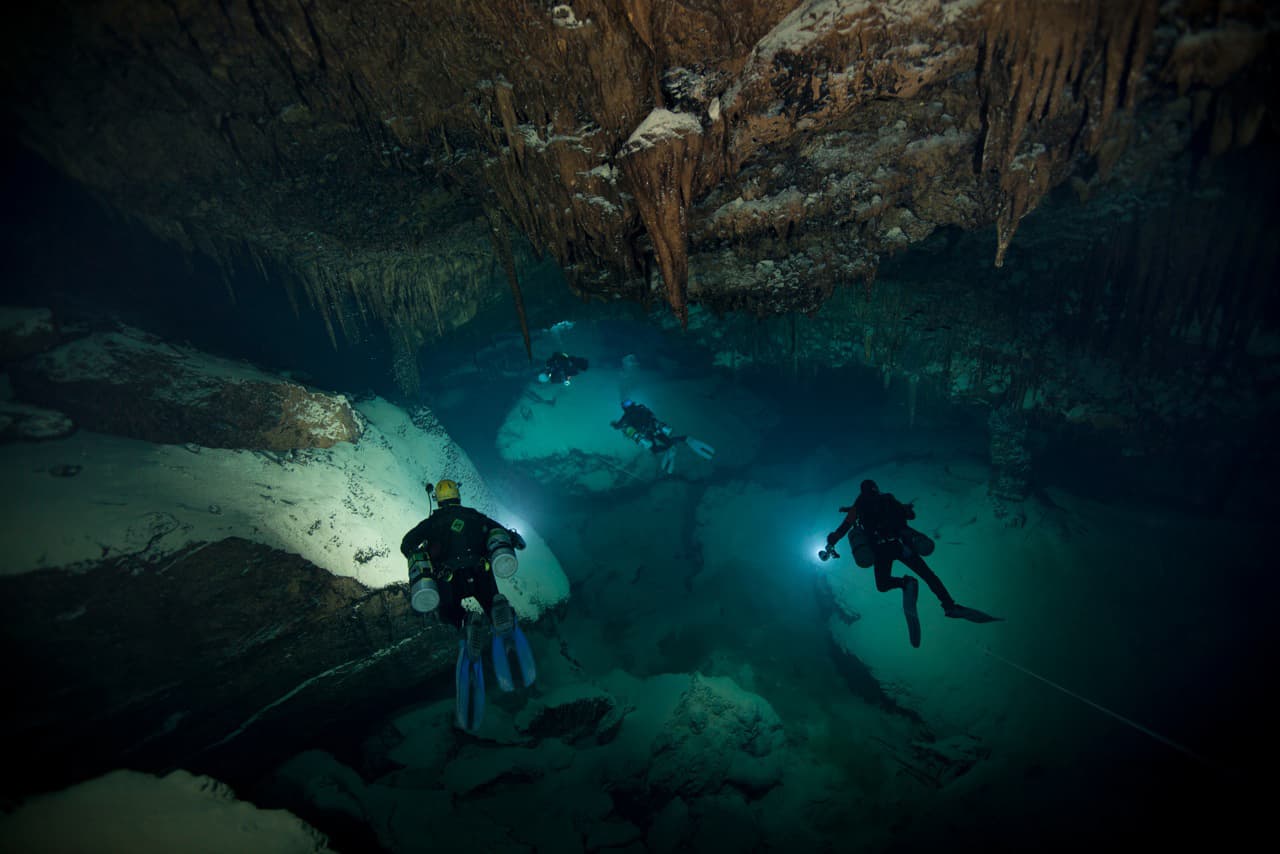
Cover photograph: sidemount divers in the Big Room of Deep Blue Cave, Bahamas, by Jill Heinerth for the Bermuda Deep Water Caves project, NOAA (public domain).

Nick is a cave and technical diver — he built to help fellow tec divers find the right instructors, centres, and tools.


