What You Need To Know About Cave Diving In Thailand

Thailand has three cave sites you can realistically plan a trip around: Sra Keow, Song Hong and Klang. All are in the south, within a few hours of Krabi, and between them they cover everything from a shallow navigation puzzle to one of the deepest cave dives in Asia.
"Sra Keow" is not one cave, though. It is a numbered cluster of at least five.
That is a smaller list than Mexico or Florida. It is also a more varied one than the number suggests, and the practicalities of getting to them are not written down anywhere obvious. This is what I learned diving them.
Why only three, in a province full of caves

Krabi is home to hundreds of submerged caves. Satun province, further south, has many more. Thailand also has a variety of flooded mines.
So the short list is not a geological limit. It is an access one.
The government decides who may dive what. Permission is granted, withheld and occasionally withdrawn, and that is the single biggest factor in which sites are open in any given year. On top of that, many cave entrances sit on private land, which means local permission from the property owner matters just as much as any official approval.
Two things follow. The first is that more sites will likely open in future — exploration and survey work is ongoing, particularly in Satun. The second is that you should never plan a trip from an article, this one included. Access changes. Talk to a cave instructor in Thailand before you book anything, because they will know what is currently open and what is not.
What is closed, and what it takes to open
The access point above is not theoretical. Here is what it looks like in practice, as of late 2026.
Khao Sok — closed to divers since 2015
Khao Sok National Park in Surat Thani holds Cheow Lan, a 165 km² reservoir created when a valley was flooded for the Ratchaprapha dam. The rising water drowned pristine cave systems that had been dry, leaving them reachable only by divers — Temple Cave, Phra Daeng with its stalactites, Peter's Cave, all shallower than 20 metres. It was close to ideal for cave training.
Two divers died in the lake in December 2014. The park authorities closed it to scuba and technical diving, and it has stayed closed since.
That is more than a decade. If you read an older article that recommends Khao Sok for cave diving, it was written before the closure and nobody went back to update it.
Worth separating from a second, unrelated story: Khao Sok's dry caves have their own history of flash-flood fatalities, including eight deaths in 2007 and a guide killed in 2024. Those were trekking accidents in Nam Thalu cave, not diving accidents, and they are a different set of closures and seasonal restrictions.
Satun — open, but only with permission
Satun province, down on the Malaysian border, is where the genuinely new exploration is happening. The Satun Cave Exploration Project has been working the Pharayabangsa massif since 2023.
What they have found there is significant. Toh Wang Cave is now confirmed as the longest freshwater cave in Thailand, with close to a kilometre of guideline laid and passages running several kilometres toward nearby sinkholes. The 20-kilometre limestone range suggests a whole network still to be mapped.
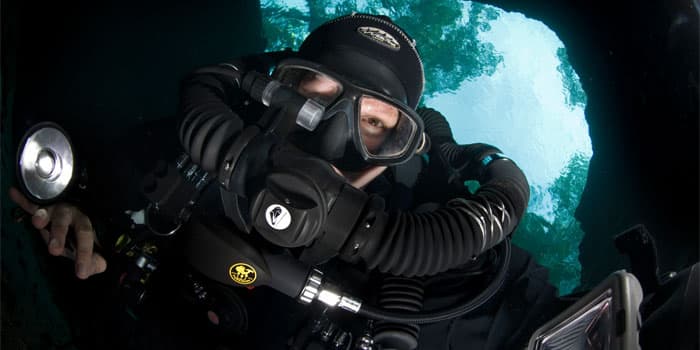
The team is the one you keep meeting in Thai cave diving: Mikko Paasi, Por Komaradat and Mika Lindström, among others. Much of it was dived on KISS Sidewinder rebreathers precisely because the unit is small enough to get through the restrictions — the argument made at length in which rebreather should you pick.
But the area sits inside Satun National Park, and the diving happened only by special permission. This is not a destination you can book. It is an expedition that negotiates its access each time.
Kanchanaburi mines — restricted as of 2026
Thailand's flooded mines are newer still. The Boh Yai complex in Kanchanaburi is a century-old lead and zinc mine, abandoned for roughly thirty years and flooded with clear groundwater — kilometres of "room and pillar" tunnels running past 100 metres deep.
The first mine dive in the country was made there in 2023. Mine Camp 2024 followed, the first mine-diving event in Asia, and a handful of divers were certified on site.
Then it stopped. Mine Camp 2026 was postponed because Boh Yai was restricted, until further notice — the Forestry Department preventing vehicles from entering the area, according to divers on the ground.
So Thailand's most interesting new overhead environment opened and closed inside three years.
What this means for planning
Three sites in three different states: one closed for a decade, one open only to a project with permission, one restricted mid-stride.
None of these is necessarily permanent. Restrictions get lifted, permissions get renegotiated, and a site that is shut this year may be diving next. The Boh Yai restriction is a Forestry Department decision about vehicle access, not a geological fact.
Which is the whole point. None of this is in any brochure, and none of it is stable — so talk to an instructor who dives here before you book flights. They will know this month's position, and an article never can.
Sra Keow 1 to 5 — the deep one, and its neighbours
Sra Keow is the go-to destination for technical cave diving in Thailand, and the name covers a cluster of numbered caves rather than a single system.
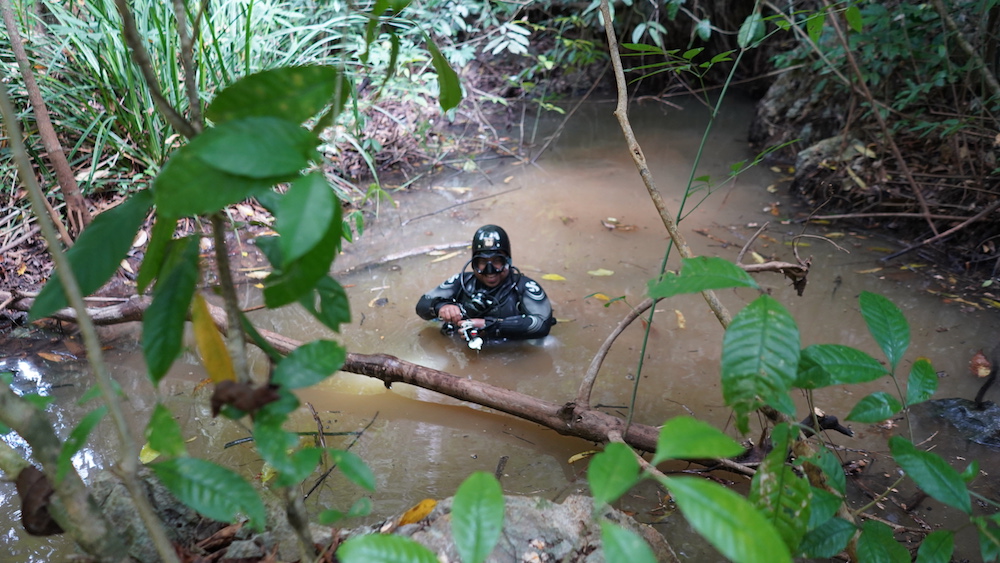
They sit close together near Ao Nang, about two and a half hours by road from Phuket. What you arrive at is not impressive: a pond roughly ten metres across in the jungle floor, with a second one beside it.
| Cave | Known depth | Notes |
|---|---|---|
| Sra Keow 1 | 239 m | The deep one. Bottomed after roughly a decade of exploration |
| Sra Keow 2 | 200 m | Connects to Sra Keow 1 underwater, at depth |
| Sra Keow 3 | around 58 m | Being dived now; thought to connect to 1, 2, or both. A hard walk in through the jungle |
| Sra Keow 4 | around 54 m | |
| Sra Keow 5 | not established |
Depths and connections here are as published by Blue Label Diving, who run cave training on these sites.
What the numbers mean in practice
Two small ponds at the surface turn out to be one cave underwater. Sra Keow 1 and 2 are joined at depth — reported at around 70 to 80 metres, and again deeper at roughly 200 metres.
That is the thing worth understanding about this site. The connections are deep. Nothing joins up in the shallows where you might stumble across it; the system only reveals itself to divers equipped to be at 80 metres and beyond.
Ben Reymenants — later one of the Tham Luang rescue divers — reached the bottom of Sra Keow 1 in 2007. In 2015 he linked the two parts of the system at roughly 200 metres in what stands as the deepest cave traverse ever dived.
Sra Keow 3 is the live question. It is being dived now and is suspected to connect to one or both of its neighbours, which would make the cluster considerably bigger than the map currently says. Getting to it is a genuine jungle walk with your kit.
Diving it without going deep
You do not need to go anywhere near 239 metres. There are routes that keep you to around 30 to 40 metres, which is why Sra Keow works as a training site as well as an exploration one.
What makes it demanding is the combination. There are deep sections past 40 metres with restrictions in them. Visibility runs roughly 3 to 20 metres depending on the day and the depth, and water temperature sits between about 23 and 29°C.
Depth, a squeeze and limited visibility at the same time is a lot to manage. Arrive as a genuinely competent and calm cave diver rather than planning to become one here.
On logistics: there is nothing at the site. Teams generally sleep and eat in Krabi and drive out, or base themselves at the Song Hong accommodation if the two are being combined into one trip.
Song Hong — the sinkhole
Song Hong is a giant sinkhole with a cave system running off it, and it is one of the deepest cave dive sites in Southeast Asia.
The main lake is about 150 metres across and drops to 100 metres straight off the shore, which is why it doubles as a trimix training site. Large tunnels leave both sides of the lake starting at around 60 metres.
The deepest surveyed point is 198 metres, and it took a long time to find. Ben Reymenants and Pekka Hartikainen pushed the line to 155 metres; Reymenants went back alone in January 2014 and reached 177.5 metres. The bottom was finally established in January 2017 by Reymenants with Dr Richard Harris and Craig Challen — the two Australian divers who, a year and a half later, would anaesthetise the boys inside Tham Luang.
At roughly 40 metres there is a traverse through to the second, smaller lake that gives the site its name: song hong means "two rooms".
Like Sra Keow, it has shallower routes that put it within reach of a cave diver without trimix — and like Sra Keow, the deep sections combine depth, restriction and poor visibility.
Song Hong is also where Tim Lawrence installed a habitat to support exploration, which tells you what kind of diving the site attracts at the top end.
Klang — the one I would go back for
Klang is the odd one out, and my favourite of the three.
It is the shallowest of the three — published as going to about 40 metres, though the routes I dived topped out around 30 on my computer. It sits over towards Ao Luk, along with the much shallower Spider Cave.
What it offers instead of depth is complex navigation. It is the closest thing Thailand has to a Mexican-style cave, with real route-finding rather than a single line in and back out, and fewer restrictions than at the other two.
Visibility can be genuinely horrendous. I have dived it in half a metre to a metre of visibility. When the water is colder it can swing the other way entirely and come close to perfect.
I would argue the bad days are the point. If you want to practise, there is no better environment than a cave with complex navigation and a metre of visibility, where line work and communication stop being theoretical.
Klang also has dry sections worth exploring on the surface, which is a pleasant way to spend an afternoon between dives.
Visibility, honestly
Thai caves do not have the visibility of Mexico or Sulawesi. Set that expectation before you arrive and you will enjoy the diving far more.
It is not constant, though. Visibility varies with the dry season and a handful of other local factors, and there are periods when it is markedly better than usual — at Klang, the clearest water I have seen came with colder temperatures.
The published ranges give you the spread: around 3 to 20 metres at Sra Keow, and anywhere from 5 to 10 metres in the shallows at Song Hong out to 30 metres or more deep inside the cave. The deep water is often the clear water.
Nobody can promise you conditions. The people who dive these sites every week can tell you what the water has been doing lately, which is the next best thing.
Getting there, and where you will stay
All three caves are inland, and none of them is close to town. Budget at least one to two hours' drive from downtown Krabi to reach any of them.
That shapes the trip more than you would expect. Rather than commuting daily from Krabi, you generally stay near whichever cave you are working on, and your guide or instructor decides where that is. When I dived with Mika Lindström I stayed in a wooden villa about twenty minutes from Sra Keow — comfortable, quiet, and much better than two hours in a van before a technical dive.
Ask where you will be based when you book. It is part of the package, and it varies by operator.
What certifications you actually need
You do not need trimix to dive these caves.
All three have routes that keep you to about 30 to 40 metres, well within a full cave certification on air or nitrox. That is the trip most visiting cave divers do.
If you want the deep sections — the parts of Sra Keow and Song Hong that make them famous — then you need trimix, or a rebreather, or both. Tech Dive Asia can accommodate either, as can several other operators on this list.
Our guides to what cave training costs and which rebreather to pick cover the step up if you are not there yet.
Exposure protection: wetsuit for caves, drysuit for mines
This is the question I get asked most, and the answer splits cleanly in two.
You do not need a drysuit for any of these caves. They run roughly 23 to 29°C, which is wetsuit territory even on a long dive.
Mines are the exception, and there you need one. Thai mine water can drop below 20°C, and a mine dive is long, slow and cold in a way the caves are not. Take a drysuit.
Worth knowing too: mine water is not always as clean as cave freshwater. Boh Yai is a former lead and zinc mine, and clear water is not the same thing as water you want soaking into your undersuit all day.
How long to go for
Three days is enough to dive all three sites. That is the standard shape of a Thai cave trip, and several operators run their intro-to-cave programmes across exactly that itinerary.
I would go for longer.
Not to tick off more sites — there are only three — but because the limited visibility makes these caves an unusually good place to drill. Line work, lost-line and lost-buddy procedures, and communication in water where you genuinely cannot see your buddy: that is hard to simulate anywhere with better conditions, and it is the most valuable thing Thailand offers a cave diver.

Frequently Asked Questions
How many cave diving sites are there in Thailand?
There are three main cave sites divable in Thailand: Sra Keow, Song Hong and Klang, all in the south within a few hours of Krabi. Sra Keow is itself a cluster of at least five numbered caves rather than a single system. Krabi contains hundreds of submerged caves and Satun province has many more, but access is controlled by the Thai government and often also requires permission from the landowner. More sites may open in future as exploration and survey work continues.
How deep are Thailand's cave dives?
Sra Keow 1 has been dived to 239 metres and Sra Keow 2 to 200 metres, making them among the deepest cave dives in Southeast Asia; Song Hong's deepest surveyed point is 198 metres. The shallower Sra Keow caves run to roughly 54 to 58 metres, and Klang goes to about 40 metres. All of the sites have routes in the 30 to 40 metre range suitable for cave divers without trimix.
Do you need trimix to cave dive in Thailand?
No. All three main cave systems have routes that stay within about 30 to 40 metres, which a full cave certification on air or nitrox covers. Trimix or a rebreather is only required for the deep sections of Sra Keow and Song Hong.
Do you need a drysuit to cave dive in Thailand?
Not for the caves — they run roughly 23 to 29°C, which is comfortable in a wetsuit. You do need one for mine diving, where water can fall below 20°C and is often less clean than cave freshwater.
What is the visibility like in Thai caves?
Generally lower than Mexico or Sulawesi. Visibility varies with the dry season and local conditions, and can range from half a metre at Klang to markedly clearer water during better periods — at Klang, colder water often brings the best visibility. Many divers treat the low visibility as a training advantage rather than a drawback.
Which Thai caves and mines are closed to diving?
Khao Sok National Park's Cheow Lan lake has been closed to scuba and technical diving since 2015, after two divers died there in December 2014. The Boh Yai mine complex in Kanchanaburi was restricted in 2026, with the Forestry Department preventing vehicle access. Cave diving in Satun province is permitted only by special arrangement, as the sites lie inside a national park. None of these closures is necessarily permanent — check with an instructor diving in Thailand for the current position.
Where is the longest cave in Thailand?
Toh Wang Cave in Satun province, near the Malaysian border, is the longest known freshwater cave in Thailand. The Satun Cave Exploration Project has laid close to a kilometre of guideline there since 2023, with passages running several kilometres towards nearby sinkholes. It is explored under special permission rather than open for recreational diving.
How far are the caves from Krabi?
Allow at least one to two hours' drive from downtown Krabi to reach any of the three systems. Most operators base students in accommodation near whichever cave they are diving rather than commuting from town each day.
How many days do you need to dive Thailand's caves?
Three days is enough to dive all three sites, and several operators run intro-to-cave programmes on exactly that itinerary. Staying longer is worth it if you want to use the low-visibility conditions to practise line work and emergency drills.
Who to dive with
Thai cave diving is a small world, and who you go with matters more than which cave you pick. The instructors running cave training here are the same people who explore these systems and, in several cases, the same people who answer when a cave floods.
Start with the instructors reviewers call a go-to for cave in Thailand, or read who's who in Thailand's technical diving for the longer introduction.
And ask about access before you book. It is the one thing about diving here that an article cannot tell you.

Nick is a cave and technical diver — he built to help fellow tec divers find the right instructors, centres, and tools.