NDL Calculator & Surface Interval Assistance
For recreational, no-decompression air dives. Enter your planned depth and bottom time to see the no-decompression limit (NDL) reference and a rough repetitive dive recommendation. Based on published SSI tables. Always follow your training and your dive computer.
Note: For Nitrox, NDL is referenced using the Equivalent Air Depth (EAD). Your planned depth may display a different table depth because EAD is rounded up to the next deeper table level per standard table usage.
Show SSI table references
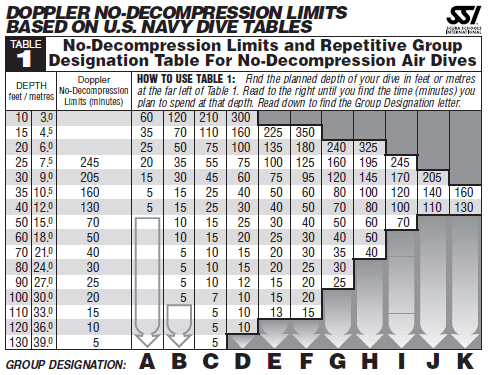
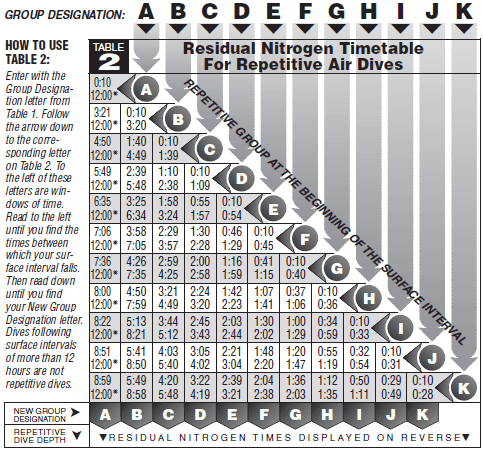
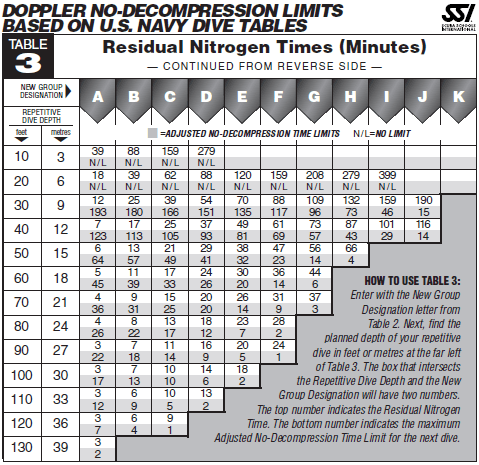
How to use the NDL calculator
Enter your planned depth and bottom time, choose Air or Nitrox, and hit Compute. For Nitrox, also enter your gas's FO2 and the maximum PO2 you plan to dive to — the calculator uses these to work out an Equivalent Air Depth before looking up your no-decompression limit.
The result shows the table depth your dive rounds up to, your maximum time before decompression (NDL), and — if you're within it — the pressure group designation SSI Table 1 assigns you, plus how long to wait (minimum surface interval) and how deep you can go on a repetitive dive. If your planned bottom time or depth goes past what the no-decompression tables cover, the calculator flags it in amber instead of returning a group designation, since that guidance stops being meaningful once you're into decompression or technical-diving territory.
On Nitrox, the calculator also shows Equivalent Air Depth (EAD), Maximum Operating Depth (MOD) for your chosen PO2 limit, the PO2 at your planned depth, and estimated CNS% and OTU oxygen-exposure figures for that single dive.
FAQ
What is NDL in diving?
NDL stands for no-decompression limit — the maximum time you can spend at a given depth on a dive and still ascend directly to the surface, with only a safety stop, and no mandatory decompression stops. It comes from how much inert gas (nitrogen, mainly) your tissues absorb at depth: the deeper you go, the faster you absorb it, and the sooner you hit the limit.
How is NDL calculated?
Recreational dive tables and computers model how nitrogen loads into a diver's tissues over time at a given depth, using a decompression algorithm (this calculator uses the published SSI tables). This tool rounds your entered depth up to the next table level and reads the corresponding NDL, group designation, and surface interval guidance directly from those tables — the same way a printed SSI table would.
What happens if I exceed my NDL?
If your bottom time goes past the NDL for your depth, you owe the water mandatory decompression stops on the way up — you can no longer ascend directly to the surface. That takes you outside recreational no-decompression diving into technical/decompression diving, which needs different training, gas planning, and equipment. This calculator flags that state rather than guessing at stop times for you.
Does Nitrox change my NDL?
Yes — Nitrox has less nitrogen than air, so it extends your no-decompression time at a given depth. This calculator handles that by converting your actual depth to an Equivalent Air Depth (EAD) based on your entered FO2, then looking up the NDL for that EAD instead of your real depth.